

1. Infrared Imaging and Vascular Feature Capture
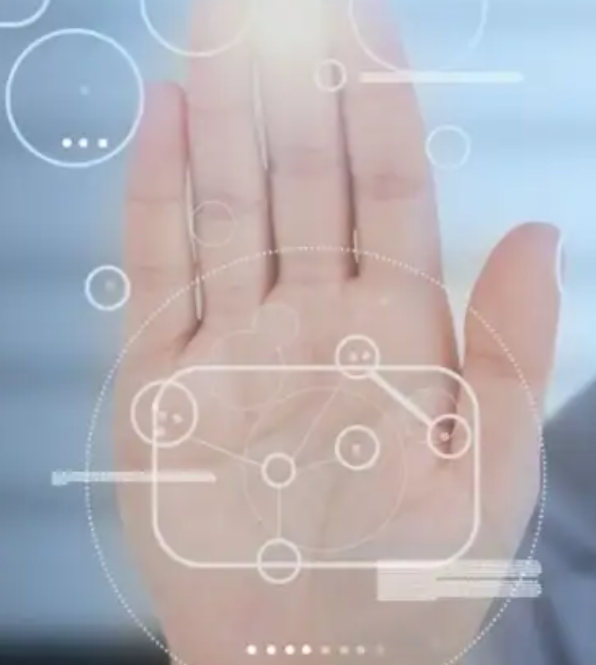
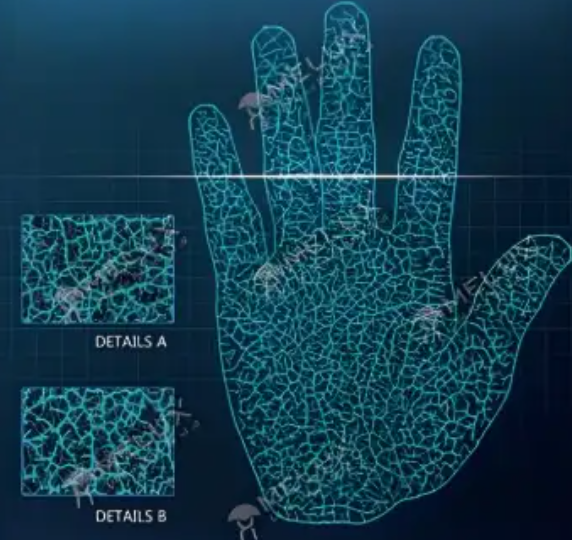
The core of palm vein recognition systems lies in obtaining images of the distribution of venous blood vessels within the palm. This process relies on Near-Infrared (NIR) imaging technology. When near-infrared light with wavelengths of 700-1000 nanometers irradiates the palm, hemoglobin in the blood absorbs specific wavelengths of infrared light, while surrounding tissues reflect the infrared light. Due to the higher concentration of deoxygenated hemoglobin in venous vessels, their light absorption characteristics differ significantly from surrounding tissues, causing venous vessels to appear as dark texture patterns on image sensors, while surrounding tissues appear as bright areas.
The imaging system typically employs near-infrared LED arrays with a wavelength of 850 nanometers, which achieves optimal balance between hemoglobin absorption characteristics and tissue penetration. High-resolution CMOS or CCD image sensors are responsible for receiving reflected light signals and converting them into digital images. To ensure image quality, the system also incorporates ambient light suppression technology and automatic exposure control mechanisms to address challenges posed by different environmental lighting conditions.
Key Technical Parameters:
- Wavelength: 700-1000 nm (typically 850 nm for optimal performance)
- Imaging Sensors: High-resolution CMOS/CCD
- Light Source: Near-infrared LED arrays
- Key Features: Ambient light suppression, automatic exposure control
2. Image Preprocessing and Feature Extraction
After acquiring the original vein image, the system needs to perform a series of preprocessing operations to enhance useful information. First, Gaussian filtering and median filtering algorithms are employed to eliminate image noise and improve the signal-to-noise ratio. Subsequently, Contrast Limited Adaptive Histogram Equalization (CLAHE) technology is used to enhance the contrast between blood vessels and the background, making vessel contours clearer.
The feature extraction stage employs a combination of direction encoding and texture analysis methods. Mainstream algorithms include:
Feature Extraction Algorithms:
- Maximum Curvature Method: Tracks vessel centerlines by calculating extreme points of image curvature
- Repeated Line Tracking Method: Simulates vessel direction patterns, recording bifurcation points and termination points
- Neural Network-based Feature Learning: Utilizes convolutional neural networks to automatically learn deep features of vascular textures
These methods convert palm vein images into feature vectors containing information such as vessel width, direction, and bifurcation point coordinates, typically stored in binary template form. This approach both protects the privacy of original biometric features and reduces storage space requirements.
3. Pattern Matching and Recognition Decision
The recognition stage employs pattern matching algorithms to compare extracted features with registered templates in the database. Similarity calculations are typically based on the following methods:
Matching Algorithms:
- Point Pattern Matching: Compares spatial distribution relationships of vessel bifurcation points and termination points
- Texture Feature Matching: Uses Gabor filter banks to extract directional texture features and perform similarity calculations
- Deep Learning Matching: Employs Siamese network structures to directly learn mapping relationships between feature vectors
The system determines matching results by setting dynamic thresholds, which are flexibly adjusted according to security level requirements and application scenarios. To improve recognition accuracy, most systems also fuse palm geometric features (such as aspect ratio, finger root positions, etc.) for multimodal authentication.

Recognition Performance Metrics:
- False Acceptance Rate (FAR): Typically less than 0.0001%
- False Rejection Rate (FRR): Typically less than 0.01%
- Equal Error Rate (EER): Industry standard below 0.1%
- Processing Time: Usually under 1 second for complete recognition cycle
4. Security Protection and Anti-counterfeiting Mechanisms
Palm vein recognition inherently possesses liveness detection advantages, as only flowing blood can present vein patterns. The system confirms biological vitality by detecting vascular pulsations and weak signal changes caused by blood flow, effectively preventing forgery attacks using photographs, models, etc. Additionally, feature templates are stored using irreversible encryption algorithms, meaning even if the database is compromised, original vein images cannot be reconstructed.
Modern systems have also introduced multispectral imaging technology, which further enhances anti-counterfeiting capabilities by analyzing vascular absorption characteristics under different wavelength infrared light. Some high-end devices can even monitor changes in blood oxygen saturation, providing dual protection for liveness detection.
Security Features:
- Inherent liveness detection through blood flow analysis
- Non-reversible template encryption
- Multispectral imaging for enhanced anti-spoofing
- Blood oxygen saturation monitoring capability
- Resistance to presentation attacks (photographs, 3D models, etc.)
5. Applications and Future Development
Due to its high accuracy, strong anti-counterfeiting capabilities, and contactless operation advantages, palm vein recognition technology has found widespread application in fields such as financial payments, access control, and medical authentication. With continuous advancements in sensor miniaturization and algorithm optimization, this technology is developing toward higher precision and lower cost, and is expected to become a mainstream solution for next-generation biometric authentication.
Current Application Areas:
- Financial Sector: ATM authentication, mobile payments, bank vault access
- Healthcare: Patient identification, prescription verification, medical record access
- Access Control: Corporate security, government facilities, data centers
- Education: Examination authentication, library access, campus security
- Government: Border control, national ID systems, voting systems
Future Development Trends:
- Miniaturization of sensors for integration into mobile devices
- Improved algorithms for faster processing and lower error rates
- Multimodal systems combining with other biometrics
- Cloud-based recognition systems for broader accessibility
- Enhanced privacy-preserving techniques