

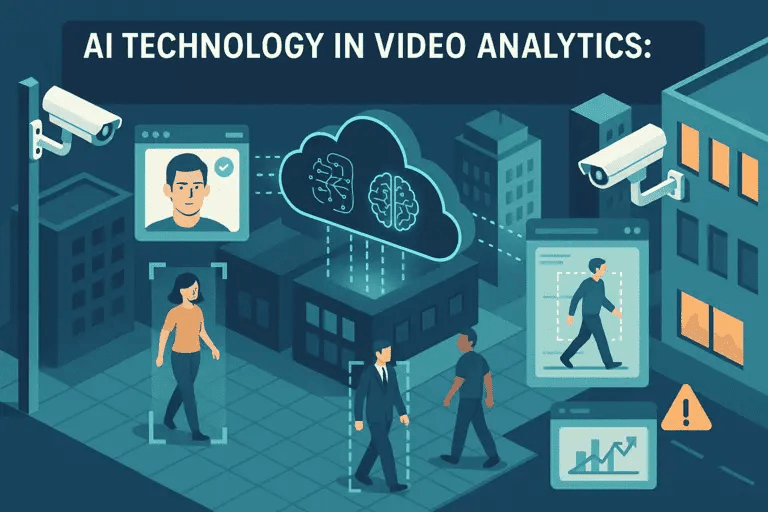
AI Video Analytics is a technology framework that applies computer vision and deep learning algorithms to continuously analyze video streams frame by frame.
The goal is to transform unstructured video data into structured, searchable, and actionable information that can be used for real-time decision-making and intelligent management.
Unlike traditional video surveillance, AI video analytics does not focus on manual video review.
Instead, it enables systems to automatically detect objects, understand attributes and behaviors, and generate structured data associated with each video frame.
Typical structured outputs include:
• Object detection results (person, vehicle, object)
• Object attributes (helmet, vest, gender, license plate, etc.)
• Behavior and event recognition (intrusion, loitering, fall detection)
• Object trajectories and temporal relationships
• Timestamped records linked to video frames
Real-Time Video Analytics vs Archive Video Analytics
Real-Time Video Analytics emphasizes low latency and high throughput.
The system must process video streams at the same frame rate as the original video, commonly 25 FPS, ensuring that analytics results are available instantly.
Key characteristics:
• End-to-end real-time processing
• Stable FPS matching the input stream
• Millisecond-level latency
• Immediate alarms and system linkage
Typical applications include:
• Intrusion and perimeter protection
• Safety compliance detection
• Real-time people counting
• Access control and alarm linkage
Archive Video Analytics focuses on post-event analysis of recorded video.
It does not require real-time processing and prioritizes data completeness and search efficiency.
Real-Time AI Video Analytics Processing Pipeline
Real-time video analytics is a continuous streaming process rather than a simple model inference task.
Processing flow:
Video Input → Video Decoding → AI Model Inference → Object Tracking & Attribute Analysis → Rule Engine → Structured Data Output
Each stage must be optimized to prevent bottlenecks and ensure long-term stable operation.

Core Technical Components
1. Video Access and Decoding
The system supports RTSP, ONVIF cameras, NVR streams, and local video sources.
Hardware-accelerated decoding is preferred to reduce CPU load and ensure stable throughput.
2. Frame Preprocessing
Frames are resized, normalized, and optionally cropped to regions of interest before inference.
Proper frame management ensures synchronization and performance consistency.

3. AI Model Inference
Detection, classification, and behavior models analyze each frame independently.
Inference is typically deployed on GPU, NPU, or dedicated AI accelerators to meet real-time requirements.
4. Object Tracking and Attribute Aggregation
Objects are assigned persistent tracking IDs across frames.
Multi-frame aggregation improves attribute accuracy and reduces false alarms.
5. Rule Engine and Event Logic
Business rules are applied to structured object data to determine events such as intrusion, safety violations, or abnormal behavior.
Rules are configurable and support multi-condition combinations.
6. Structured Data Output
Final results are stored as structured records with timestamps, camera IDs, and object attributes.
Data can be stored in databases or delivered via APIs to platforms, dashboards, or third-party systems.
System Design Challenges
• Long-term stability under continuous operation
• Multi-channel scalability
• Coordination between algorithms and system architecture
• Limited computing resources at the edge
Real-time AI video analytics is not just a model deployment task.
It is a complete engineering system that integrates algorithms, hardware acceleration, and software architecture.
Conclusion
Real-time AI video analytics enables video systems to move from passive monitoring to active intelligence.
By continuously transforming video streams into structured data, organizations can achieve faster response, higher safety standards, and improved operational efficiency.
The true value lies not in recognition itself, but in the ability to reliably convert video into real-time, actionable intelligence.